

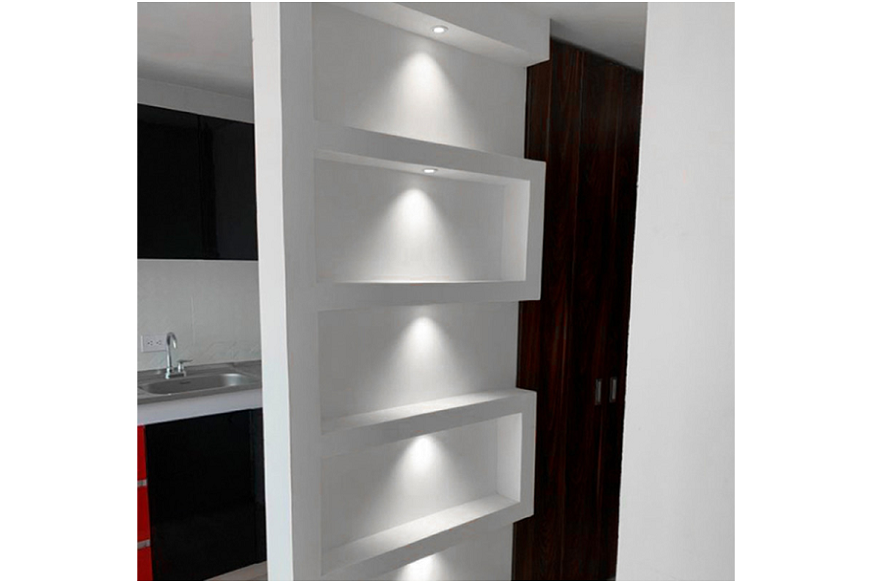
Understand what the 12 V rating means
A square 12 V luminaire is a low-voltage light fitting intended for a suitable supply, not a device that should be connected directly to household mains. The particular product specification determines whether the input is 12 V DC or another stated form, as well as the polarity and rated power. The shape makes square modules useful for repeated lighting points in cabinets, display niches and compact furniture. Begin with a circuit plan before deciding how many fittings to use.
Choose point lighting deliberately
Square fittings create localized patches of light rather than one continuous luminous line. This can work well for individual cubbies, small shelves or a grid of display compartments. Mark the centre of each intended light pool and evaluate whether nearby objects will cast distracting shadows. If a long countertop needs even illumination, several square units require careful spacing and may still give a different result from a linear fixture.
Read More: How to Cool a Room Without AC
Set the spacing around actual beam angles
The correct distance between square luminaires depends on their optical distribution and the height above the target surface. Closely spaced units can create excessive overlap, while widely separated units leave dark gaps. Square 12V Luminaires is one product category to compare against these installation requirements. Use the manufacturer’s beam information where available and test a sample above the intended shelf depth. A quick full-size layout on cardboard often reveals alignment problems that are difficult to spot on a small drawing.
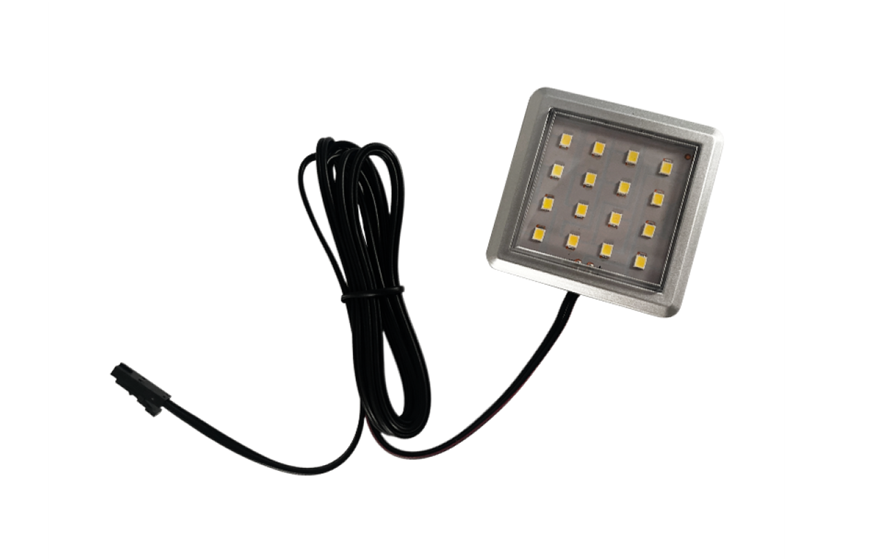
Plan power supply capacity
Add the rated wattage of every fitting on the circuit. For a DC system, the basic relationship between total power, voltage and current helps determine expected cable and supply load. Select a properly specified power supply with capacity for the complete installation and check the rated load of any controls or connectors. The driver should remain accessible and ventilated as its documentation requires. Do not extend the circuit indefinitely without considering current and conductor sizing.
Watch voltage drop on longer cable runs
Low-voltage lighting can be sensitive to resistance in long, thin wires. Voltage drop may reduce brightness toward the end of a run, particularly when several fittings share a long supply cable. Compare branch and distribution layouts, choose adequate wire cross-section and keep high-current paths short where practicable. Where individual fittings use polarized connectors, maintain correct orientation throughout. A final voltage check under operating load can expose weak or undersized connections.
Choose surface or recessed installation early
A recessed square module needs a correctly sized opening and enough free depth for the fitting and cable bend. Surface-mounted variants have different clearance and fastening requirements. Check the precise cut-out drawing, not merely the visible outer dimensions. Confirm that screws and retaining clips avoid thin furniture edges and hidden shelf supports. On a finished cabinet, a surface-mounted arrangement may preserve the panels and simplify later changes.
Coordinate finish and light colour
A repeated grid of square lights forms a visible design rhythm. Matching body finishes create consistency when the fixtures are exposed. Neutral white can suit utility storage or contemporary merchandise displays, while warm light complements timber and softer residential interiors. The diffuser and optical design influence glare, especially when a lower shelf is viewed from a seated position. Test the system with neighbouring room lights on and off.
Keep connections reachable
A cabinet containing many independent luminaires needs an orderly wiring plan. Use properly rated junctions and protect wire entries where cables pass through wood or metal panels. Label each circuit when the layout is complex, and leave sensible service access near distribution points. Before fitting cabinet backs or trim, confirm that every luminaire illuminates correctly and that its polarity and switching match the plan.
Specify square fixtures with the whole circuit
Square 12V Luminaires provide a category to review for low-voltage furniture lighting with a compact geometric appearance. Confirm the exact input rating, dimensions, mounting style and light distribution of each selected model. A disciplined wiring plan and consistent layout are what turn a set of small squares into an effective lighting system.
Example: a nine-compartment display grid
A display unit consists of nine square compartments arranged in three rows. The designer wants a square luminaire centred near the top of each cell. Marking all nine positions from a shared reference prevents the fittings from drifting out of alignment across the structure. The installer then calculates the total rated power, plans a distribution route and checks whether branch lengths are appropriate. A single sample fitting is mounted in one compartment and tested with typical display items. This test reveals whether the light pool is broad enough and whether an exposed emitter causes glare. Only after those checks should the remaining cut-outs or fastener positions be completed.
Understanding the power calculation
For an illustrative installation, six fittings rated at 3 W each represent an 18 W lighting load. On a 12 V DC circuit, that corresponds to 1.5 A in an ideal steady-state calculation before allowing for specific driver characteristics and design margin. These figures are a mathematical example, not a rating for any particular LEDUA product. Actual selections require the wattages printed in the product specifications. The cable size and driver rating must suit the layout and applicable standards. Long parallel branches may behave differently from a daisy-chained supply because current distribution and voltage drop depend on the topology.
Commissioning and troubleshooting
Before enclosing the wiring, verify polarity where required and confirm that all fittings illuminate at the intended brightness. If one square lamp is noticeably dimmer, check its connectors and the voltage at the fixture under load, using safe measurement practices. Identify whether the issue is a specific luminaire or a common supply branch. Examine mounting holes for sharp edges and protect cables passing through them. A clean wiring diagram with fixture numbers will make future maintenance easier. The installation is complete only after the full group has been tested with its final control method and real display contents.
Read More: 5 Tips For Farming Enthusiasts To Grow Vegetables At Home
For related furniture and architectural lighting components, the LEDUA catalogue offers a wider range of fittings, electrical accessories and installation options. Select each component from its actual technical documentation and coordinate the complete assembly before installation.